
IITianPrepLab

standsweb November 10, 2026 No Comments

JEE Main 2027 Session 1 Registration Open: Apply Before 22 November 2026

JEE Main 2027 Session 1 Registration Open: Apply Before 22 November 2026 The National Testing Agency (NTA) has started the online registration process for JEE Main 2027 Session 1. Students aspiring to pursue engineering, architecture and planning courses at reputed institutions across India can now submit their application forms through the official JEE Main website. The registration process began on 24 October 2026, and eligible candidates can apply until 22 November 2026 without a late fee. Students who are planning to appear for the January 2027 examination should complete their application process before the deadline. JEE Main is a national-level entrance examination conducted by NTA for admission to undergraduate engineering, architecture and planning programmes. It is also an important qualifying examination for students aspiring to appear for JEE Advanced and secure admission to Indian Institutes of Technology (IITs), subject to the prescribed eligibility conditions. JEE Main 2027 Session 1: Overview Particulars Details Examination Name JEE Main 2027 Conducting Authority National Testing Agency (NTA) Session Session 1 – January 2027 Application Mode Online Registration Start Date 24 October 2026 Last Date to Apply 22 November 2026 Late Fee Application Period 23–26 November 2026 Examination Month January 2027 Official Website jeemain.nta.nic.in JEE Main 2027 Important Dates Candidates should keep track of the important dates related to the registration process and examination. Event Date Online Registration Begins 24 October 2026 Last Date to Apply Without Late Fee 22 November 2026 Last Date for Fee Payment 22 November 2026 Application with Late Fee 23–26 November 2026 Application Correction Window 27–29 November 2026 Examination City Announcement 30 December 2026 Admit Card Release 13 January 2027 JEE Main Session 1 Examination 20, 21, 22, 23, 24 and 28 January 2027 Note: Candidates should check the official NTA website for the latest schedule and any subsequent changes. How to Apply Online for JEE Main 2027 Session 1? Students can complete their JEE Main 2027 application process online by following the steps given below. Step 1: Visit the official website of JEE Main at https://jeemain.nta.nic.in/. Step 2: Click on the “Online Application Form for JEE (Main) 2027 – Session 1” link. Step 3: Select the new registration option and read the instructions carefully. Step 4: Enter the required personal details, mobile number and email address to complete registration. Step 5: Log in using the application number and password or the prescribed login credentials. Step 6: Fill in the application form with your academic details, examination paper preferences and examination city choices. Step 7: Upload your photograph, signature and other required documents in the specified format. Step 8: Pay the application fee using the available online payment options. Step 9: Review all the information entered in the application form. Step 10: Submit the application and download the confirmation page for future reference. Candidates are advised to use their own login credentials and ensure that their personal details match their official academic and identity documents. JEE Main 2027 Eligibility Criteria Before submitting the application form, candidates should carefully review the eligibility conditions. Educational Qualification Candidates who passed Class 12 or an equivalent qualifying examination in 2025 or 2026 are eligible to apply. Students appearing for their Class 12 or equivalent examination in 2027 can also apply, subject to NTA guidelines. Candidates must satisfy the prescribed subject requirements for their selected examination paper. Age Limit There is no age limit for appearing in JEE Main 2027. However, candidates must fulfil the admission eligibility requirements of their preferred institutions. Admission Eligibility For admission to NITs, IIITs and other participating institutions, candidates must meet the applicable Class 12 marks or top 20 percentile criteria, as prescribed in the admission guidelines. JEE Main 2027 Examination Papers JEE Main 2027 offers different examination papers according to the course students wish to pursue. Paper 1 – B.E. / B.Tech Paper 1 is conducted for admission to undergraduate engineering programmes. It covers three major subjects: Mathematics Physics Chemistry Paper 2A – B.Arch Paper 2A is designed for candidates seeking admission to Bachelor of Architecture programmes. It includes Mathematics, Aptitude and Drawing. Paper 2B – B.Planning Paper 2B is conducted for admission to Bachelor of Planning programmes. It includes Mathematics, Aptitude and Planning-related questions. JEE Main 2027 Exam Pattern The examination pattern helps students understand the structure of the question paper and prepare accordingly. Subject / Paper Number of Questions Mathematics – Paper 1 25 Physics – Paper 1 25 Chemistry – Paper 1 25 Total Questions – Paper 1 75 Paper 1 is conducted in Computer-Based Test (CBT) mode. It includes multiple-choice questions and numerical-value questions. Students should refer to the official information bulletin for the detailed marking scheme, question distribution and examination instructions. Documents Required for JEE Main 2027 Registration Candidates should keep the necessary information and documents ready before beginning the application process. Valid mobile number and email address. Recent passport-size photograph. Scanned signature. Class 10 certificate or marksheet details. Class 12 academic details, wherever applicable. Category certificate, if applicable. PwD/PwBD-related documents, if applicable. Valid identity details as required by NTA. All documents must be uploaded according to the specifications mentioned in the official application guidelines. JEE Main 2027 Preparation Tips for Students With the January 2027 examination approaching, students should follow a well-planned preparation strategy. 1. Understand the Complete Syllabus Start by reviewing the latest JEE Main syllabus for Mathematics, Physics and Chemistry. Identify important chapters and topics that require additional attention. 2. Prepare a Daily Study Timetable Divide your study hours among all three subjects. Maintain a balance between learning new concepts and revising previously studied topics. 3. Practise Previous Year Questions Solve previous years’ JEE Main question papers to understand the examination pattern and identify frequently tested concepts. 4. Focus on Mathematics Formulas Maintain a separate formula notebook for important mathematical concepts, identities, shortcuts and equations. 5. Attempt Mock Tests Regularly Mock tests help improve time management, accuracy and confidence before the actual examination. 6. Revise Important Topics Regular revision is essential for remembering formulas, strengthening concepts and avoiding repeated mistakes.

standsweb November 10, 2026 No Comments

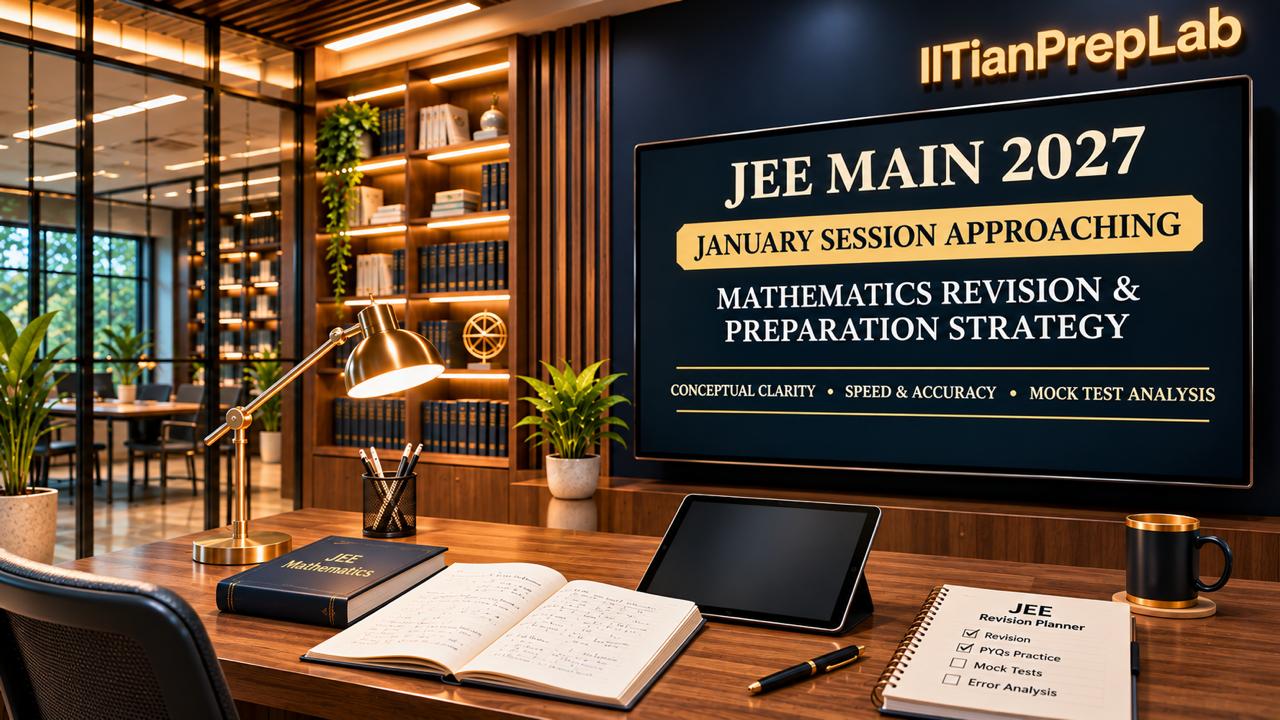
JEE Main 2027 January Session Approaching: Smart Mathematics Revision, Speed & Accuracy Strategies

The JEE Main 2027 January Session is approaching, and students are entering one of the most important stages of their engineering entrance examination preparation. With limited preparation time remaining, candidates should focus on smart revision, effective problem-solving techniques, and improving their speed and accuracy, especially in Mathematics. Mathematics is one of the most important subjects in JEE Main. It requires a clear understanding of concepts, regular practice, logical thinking, and the ability to solve questions within a limited time. Simply studying more chapters may not be enough at this stage. Students should adopt a strategic revision plan that helps them strengthen important concepts, remember essential formulas, and avoid unnecessary mistakes. In this article, we will discuss effective Mathematics revision strategies, important topics, time-management techniques, and practical tips to improve performance in JEE Main 2027. 1. Focus on Smart Mathematics Revision As the examination approaches, students should avoid starting too many new topics unless they are essential. Instead, concentrate on revising previously studied chapters and strengthening conceptual understanding. An effective revision strategy should include: Revising important mathematical concepts and formulas. Practising questions from previously completed chapters. Solving JEE Main previous year questions. Identifying frequently repeated question patterns. Reviewing mistakes made during mock tests. Giving additional attention to weak topics. Students should prepare short revision notes for each chapter. These notes should include important formulas, identities, properties, shortcuts, and commonly used methods. 2. Important Mathematics Chapters for JEE Main 2027 Mathematics covers several topics from Class 11 and Class 12. Students should revise the complete prescribed syllabus while giving appropriate attention to important chapters. Algebra Complex Numbers Quadratic Equations Matrices and Determinants Permutations and Combinations Binomial Theorem Sequences and Series Probability Calculus Limits, Continuity and Differentiability Applications of Derivatives Indefinite Integration Definite Integration Differential Equations Coordinate Geometry Straight Lines Circles Parabola Ellipse Hyperbola Trigonometry Trigonometric Functions Trigonometric Identities Inverse Trigonometric Functions Vector Algebra and Three-Dimensional Geometry Vectors Three-Dimensional Geometry Direction Cosines and Direction Ratios Lines and Planes in Three Dimensions Preparation Tip: Do not depend entirely on expected weightage or selective chapters. Cover the complete official syllabus and prioritise topics according to your preparation level and performance in practice tests. 3. Improve Mathematics Speed with Regular Practice Speed plays an important role in JEE Main because students must solve questions within a fixed examination duration. Here are some effective ways to improve problem-solving speed: Practise Timed Questions: Set a time limit while solving Mathematics questions. Gradually reduce the time required without compromising accuracy. Learn Formula Applications: Memorising formulas is not enough. Understand where and how to apply them to solve questions quickly. Avoid Lengthy Calculations: Look for suitable mathematical identities, substitutions, and alternative solving methods whenever appropriate. Solve Previous Year Questions: Practising previous year questions helps students become familiar with different question patterns and common problem-solving approaches. Develop Mental Calculation Skills: Improve basic arithmetic, algebraic simplification, squares, cubes, and other calculations to save time. 4. Accuracy Is More Important Than Blind Attempts Solving questions quickly is useful only when the answers are correct. Negative marking can affect the overall score, so students should focus on accuracy rather than attempting every question. Follow these strategies to reduce mistakes: Read every question carefully before solving. Check signs, units, values, and calculation steps. Avoid guessing when you are unsure. Recheck answers whenever time permits. Practise questions involving multiple steps. Analyse incorrect answers after every mock test. Students should also identify whether their mistakes are caused by weak concepts, calculation errors, incorrect formula selection, or poor time management. 5. Create a Daily Mathematics Revision Timetable A proper daily schedule helps students maintain consistency and cover important topics systematically. Here is a sample Mathematics-focused daily revision timetable: Activity Suggested Time Formula Revision 30 Minutes Concept Revision 60 Minutes Chapter-Wise Practice 90 Minutes Previous Year Questions 60 Minutes Timed Question Practice 45 Minutes Mistake Analysis 30 Minutes Students can adjust the timetable according to their individual preparation levels and the time available before the examination. Remember to maintain sufficient time for Physics and Chemistry as well. 6. Practise JEE Main Mathematics Previous Year Questions Previous Year Questions (PYQs) are an essential part of effective JEE Main preparation. They help students understand: The examination question format. Frequently tested mathematical concepts. Different levels of question difficulty. Common calculation patterns. Time required to solve different question types. Try solving chapter-wise PYQs first. Once you become comfortable with individual topics, attempt complete Mathematics sections under timed conditions. Students should also review the solutions carefully to understand alternative approaches and improve their problem-solving techniques. 7. Take Mock Tests to Improve Exam Performance Mock tests are one of the most effective ways to evaluate your preparation before the actual examination. Regular mock tests help students: Improve time management. Identify strong and weak chapters. Practise under examination-like conditions. Improve question selection. Reduce examination anxiety. Build confidence and consistency. After completing each mock test, spend time analysing your performance. Do not focus only on the total score. Check the number of correct answers, incorrect attempts, unattempted questions, and time spent on individual questions. 8. Smart Time Management During the Examination Managing time effectively is essential for scoring well in JEE Main. Students should follow a practical examination strategy: First Round – Easy Questions: Start with questions that you can solve confidently and quickly. Second Round – Moderate Questions: Attempt questions that require additional calculations or multiple steps. Third Round – Difficult Questions: Return to challenging questions if sufficient time remains. Final Review: Use the remaining time to verify calculations and check unanswered questions that you can solve confidently. Avoid spending too much time on a single difficult question. Moving forward strategically can help maximise your overall performance. 9. Common Mathematics Preparation Mistakes to Avoid During the final preparation phase, students should avoid the following mistakes: Starting multiple new reference books. Ignoring formula revision. Practising without a time limit. Avoiding mock test analysis. Spending too much time on difficult questions. Neglecting previously studied chapters. Ignoring calculation mistakes. Focusing only on Mathematics while neglecting Physics and Chemistry.